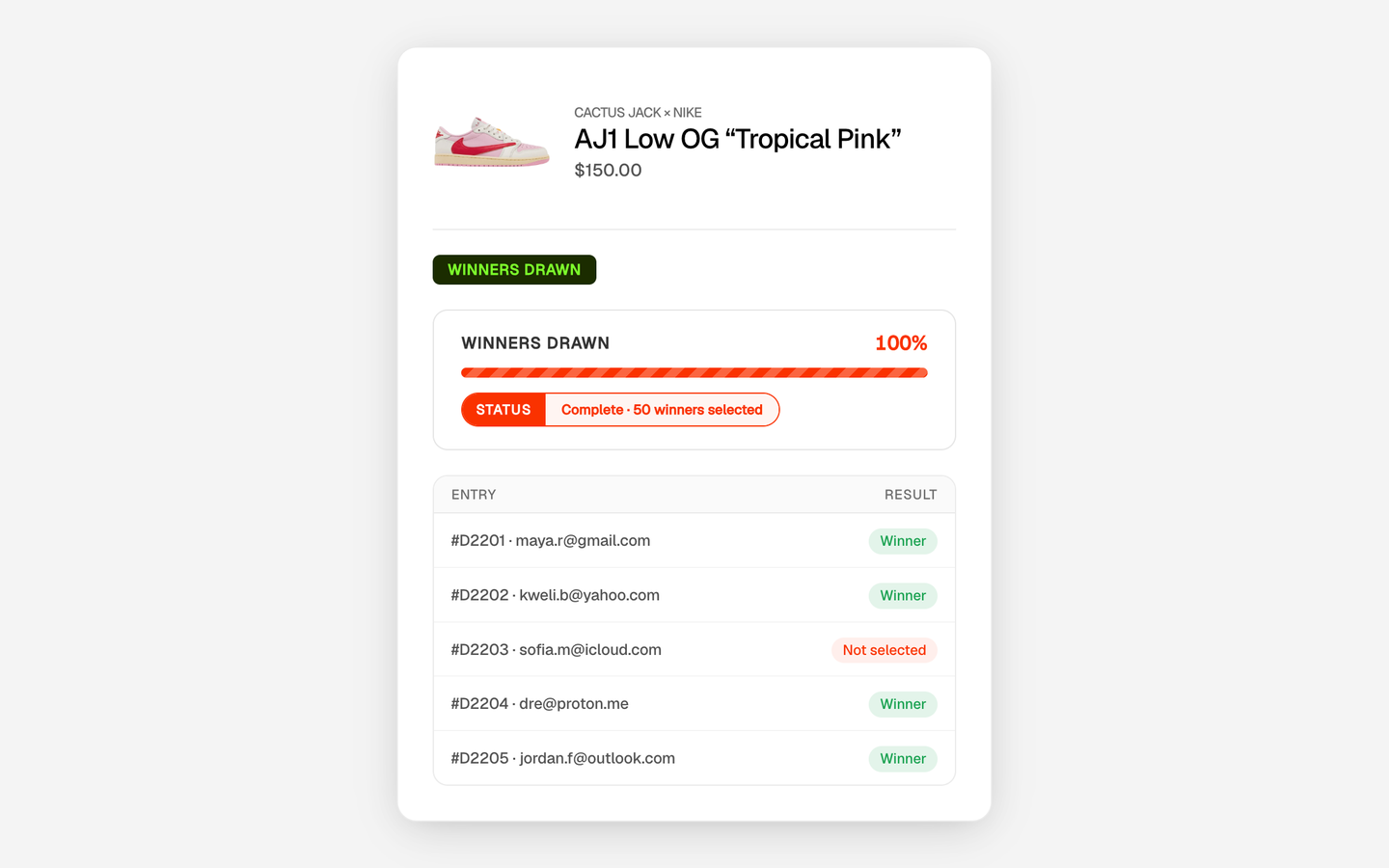
What a draw is
A draw is a way to sell a limited product when more people want it than you have stock. Instead of selling to whoever checks out fastest, you open an entry window on the product page. Fans enter during that window. When it closes, winners are picked at random from the clean entries, and only the winners buy.
Speed does not matter. An entry placed in the first second and an entry placed an hour later have the same odds. What matters is that the entry is real: one person, one entry, and no bot behind it.
Compare that with a first come, first served drop. The product goes live at a set time and the fastest checkout wins, which rewards the quickest connection or the best script. A draw removes the race. Fans enter once, at $0, and hear back when the draw closes.
- First come, first served: the fastest checkout wins and bots have the advantage.
- Draw: entries collect over a window, filters remove bots and duplicates, winners are picked at random, and everyone else is never charged.
Why brands run draws
Bots and resellers win speed races. A bot completes a checkout faster than any person, and a reseller runs many of them at once. On a first come, first served drop the stock goes to whoever ran the best script, and a botted win becomes a resale listing in 90 seconds.
Real fans get a fair shot. A draw rewards loyalty, not click speed. Everyone who enters has the same odds, and if you want to reward your most loyal customers, you can do that without breaking the fair draw. More on that below.
You can measure demand. Entries are a count you can hold against stock. When Cactus Jack released the Phantom 6 Low Elite as a Pay After draw, entries reached 9.2x available stock, 818% more entries than inventory. That is a number you can plan the next release around, and one a sold out page never gives you.
There are two quieter benefits. The storefront stays live. The Phantom 6 release ran with no queue, no downtime and no waiting room. And the money side is calm. On the Pink Pack draw, fans entered at $0 and paid $155 only if they won, $0 was charged to everyone not selected, and the drop produced 0 surprise charges, disputes or chargebacks.
How a draw works on Shopify
With SuperSwipe the whole draw runs on your own product page. The app adds an Enter Draw button through a Shopify native block that you place in the theme editor, so it inherits your fonts, colors and layout. Fans never leave your store, and they do not need an account or an extension to enter. Here is the flow for a standard draw.
-
A fan taps Enter Draw
Before confirming, the fan sees the terms in plain English: $0 charged today, full price only if their entry is picked.
-
The entry is confirmed at $0
The fan lands on a normal order confirmation page and gets an entry receipt by email from your store. They can check their status from their order page, see when the draw closes, and cancel anytime.
-
Entries close and filters run
When the window closes, the bot filters sweep the pool. Bots, duplicates and risky cards are removed before anyone is picked.
-
Winners are drawn live
The button on your product page turns into a live selection feed. Everyone watching sees the same percentage tick to 100% as winners are drawn at random from the clean pool.
-
Winners pay
Selected fans get a winner email branded from your store. In a standard draw this is when the card is charged, and from there it is a regular Shopify order that ships like any other.
-
Everyone else is closed out
Fans who were not picked get a calm email confirming the draw closed and their card was never charged. No refund flow, no card capture.
The full walkthrough is on the how it works page. If you are ready to set one up, the guide to running a product draw on Shopify covers it from install to shipping.
Two ways winners pay
Every SuperSwipe release starts with one choice: how winners pay. Fans see the same button either way. What changes is what they commit to at entry and when the money moves.
Standard, also called charge on win, takes the entry through Shopify checkout. The fan saves a payment method, pays $0 today, and the card is locked before the draw closes. When you end the draw, winners are charged automatically and their orders are created on the spot. Nobody else is charged a cent. Standard ran the Pink Pack drop, and it suits high heat drops where you want revenue locked the second the draw ends.
Pay After drops the card entirely. Fans fill in a short form with their name, email, phone, address and size, and no card. After selection, winners receive a private checkout link by email and SMS and pay while supplies last. Links go out in timed waves matched to your live stock, and unused links recycle to the next fan in line, so you never oversell. Because entering asks for so little, reach goes up. Pay After carried the Phantom 6 release, where the Cleats and IC SE both sold through.
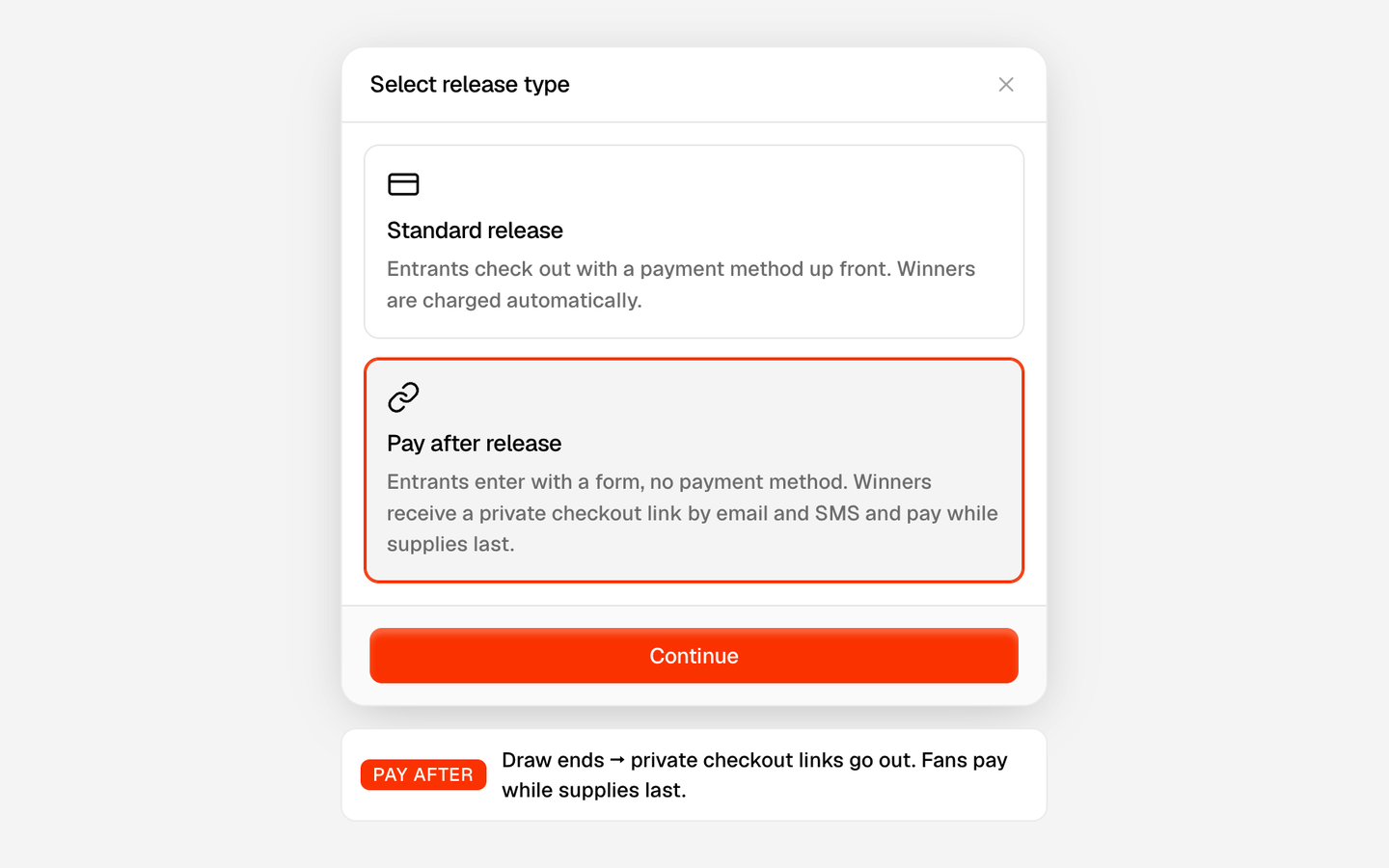
For a side by side breakdown of entry, payment and stock in each mode, read charge on win vs Pay After or the release modes page.
What makes a draw fair
A draw is only fair if the pool is clean, the selection is random, and nothing outside the draw changes the odds.
- Bots and duplicates are filtered before anyone is picked. Every entry runs through the same wall, five filters covering network, identity, location, account and risk, with no captcha and nothing for the fan to install. Real fans walk straight in.
- Every decision has a reason. Each entry is sorted as clean, filtered or flagged, with the exact reason attached. Flagged entries are held for your review and never removed automatically, and you can reinstate any entry the wall caught by mistake.
- Selection runs in public. When the window closes, your product page shows a real percentage ticking up as entries are sorted, bots are stripped out and winners are drawn. Winners and the fans who missed out see the same feed at the same moment. No favorites, no hand picked winners, and the store cannot tilt the draw.
- Nothing a fan can buy changes the odds. There are no paid tiers, no memberships and no subscription that sells a better chance of winning.
- Fans never pay a SuperSwipe fee. Entering is $0, always. Winners pay the retail price through your own Shopify checkout, and the 5% fee per selected entry is billed to the store only.
Read more about the filtration wall and the live draw, or see how they compare with a hosted platform in SuperSwipe vs EQL. If bots are your main worry, the guide on stopping bots on Shopify product drops goes deeper.
When a draw is the right choice
A draw earns its place when demand is clearly above stock. Some signs you are there:
- Your last release sold out in minutes and resale listings appeared the same day.
- The product is a collaboration or a hyped release, the kind fans line up for.
- Stock is limited by size, so some variants will be gone no matter what you do.
- You want to know how many people wanted the product, not just how many got it.
If stock comfortably covers demand and there is no reseller interest, a plain first come, first served release is fine. A draw adds a window between entry and purchase, and that only pays off when the alternative is a race.
A draw is set up per product, so you can run the hyped collaboration as a draw and leave a restock on a normal product page. The limited release strategy guide walks through picking the format, setting stock by size, choosing the entry window and rewarding loyal fans.
Questions brands ask
Do fans need an account to enter?
No. There is no registration, no verification and no login. Fans enter with their email and the details the entry asks for. Fans who want to track every draw they enter can sign in to SuperFan later with the email they used at checkout, but it is never required.
Do fans pay anything to enter?
No. Entering is $0 and fans never see a service fee. Winners pay retail through your Shopify checkout, and the store pays 5% per selected entry. SuperSwipe is free to install, with no contracts and no minimums.
Can I reward loyal customers without breaking the draw?
Yes. VIP access works two ways. Silent wins let your VIPs enter like everyone else, clear the same bot wall, and get prioritized during selection, and nothing public signals the edge. Draft order links skip the draw: SuperSwipe creates a private Shopify draft order, reserves the inventory for 72 hours, and emails the VIP a private checkout link. You can run either mode, or both, on the same release. Details are on the VIP mode page.
How long should entries stay open?
You set the entry window when you set the rules for the release, along with allowlists and card rules. There is no single right length; it depends on how you announce the drop. The strategy guide covers how to choose the window for your release.
What happens if a winner's card fails?
In a standard draw you can replace the winner in one click, so the product goes to another fan. In Pay After there is no card at entry, and unused checkout links recycle to the next fan in line automatically.